A new spam update has been rolling out since 24 September 2026.

Lead Lagoon
Google spam updates — June, August and September 2026

Your Google traffic dropped to zero. I have THE solution.

Here is exactly what you need to do to bring it back.

In August 2026, the spam update took several of my sites down. It took me twenty-one days to bring the first one back. I then applied the same sequence, in the same order, to 23 sites totalling 25,000 visits a month: 18 came back.

This document is that sequence. Phase by phase, in the exact order I run it.

$69 — less than your site earns you on a normal day. And how many lost days are you at now?

Agency method, run on 23 sites Every claim sourced from Google Instant download

23 sites. 18 came back.

This protocol was not written from one isolated case. I applied it, in this order, to 23 sites hit by the 2026 spam updates — roughly 25,000 combined monthly visits — refining it on every pass.

23

sites the sequence was run on

18

saw their traffic return

78%

recovery rate overall

5

produced nothing — and I tell you which

One case in detail — the first

Google Search Console — clicks / day
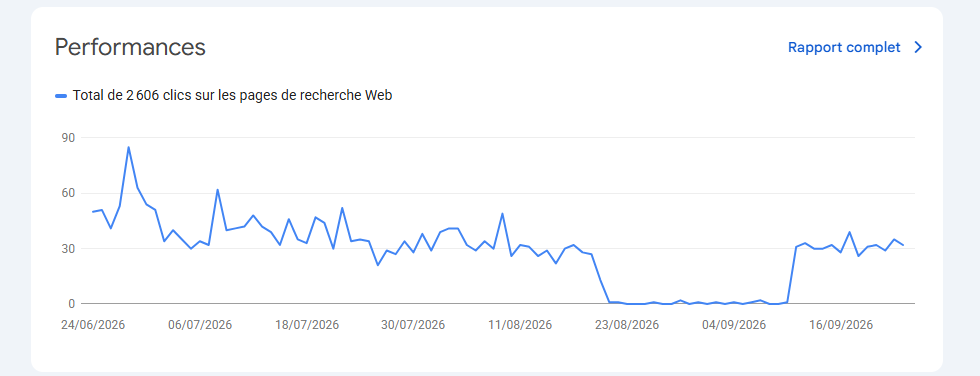
Google Search Console performance report: clicks dropping to zero on 23 August 2026, then returning to the previous level on 14 September 2026
Aug 23 — collapse
Sept 14 — recovery
21 days at zero — running the protocol

← swipe the chart →

0

clicks a day, 24 August to 13 September

21 d

between the collapse and the return

105%

of the previous level (30.3 → 31.9 clicks/day)

Why show this one, and not the biggest? Because it is one of my own sites, so I can publish its curve without exposing a client's data. The volumes are modest — around thirty clicks a day — but the pattern is unusually clean: a drop to absolute zero, then a return. On the higher-traffic sites, the same sequence produced the same movement at a different scale. The Search Console interface is in French: this is my own unedited screenshot.

Raw capture of the Google Search Console "Performance" report, annotations added. The August 2026 spam update rolled out from 18 to 21 August, the June one from 24 to 26 June (dates published on the Google Search Status Dashboard).

And the 5 that produced nothing

Better you hear it before you pay: on .biz, .ovh and .xyz domains, this sequence produced no recovery at all. If your site is on one of those extensions, do not buy this document — it will be of no use to you, and you will have spent $69 for nothing.

The 18 recoveries are spread across .com (47%), .fr and .net domains. Those are the extensions — and the only ones — where I have results to show.
The worst part isn't the drop.
It's not knowing what to touch.

On the morning of 23 August I open Search Console like any other day. Zero. Not "down 40%". Not "a bad day". Zero clicks. I refreshed three times telling myself it was a display bug. The next day, zero again. And the day after that.

— Stéphane Dubart

Google does not warn you. No message, no manual action in Search Console, no list of offending pages, no indication of what was judged. Just a curve flattening one morning — and a forum full of people telling you to "improve your content".

So you do what everyone does. You rewrite three articles. You change some titles. You request indexing again. The next day nothing has moved, so you change something else. A month later your site has changed fifteen times and no movement is interpretable any more: you no longer know what caused what. You have lost the only thing that mattered — the ability to read Google's answer.

This is not a problem of effort. It is a problem of order.

Three questions you cannot answer today

  • 1 Was it really the spam update that hit you — or a technical problem you are currently ignoring?
  • 2 Which pages should you work on: the whole site, or only part of it — and which part?
  • 3 How long must you wait without touching anything before concluding it did not work?

Until you have those three answers, every day of work on your site is as likely to make things worse as to fix them. The document answers all three — in order, with the official sources alongside.

While you search, the bill keeps running.

A site at zero does not cost you "traffic". It costs orders, quotes, calls, sign-ups — every day, weekends included. Put your own numbers in and you will see yours.

$480

per day

$14,400

per month

$175,200

over a year

At that rate, the document pays for itself in under two days of recovered traffic.

Stop the bleeding — $69

Indicative estimate based on the values you enter. No data is sent anywhere: the calculation runs in your browser.

You have four options. Not one more.

Wait
$0

Google does not come back on its own to a site it has downgraded. As long as nothing changes, nothing changes — and the bill above keeps running.

Improvise
free, and very expensive

Change whatever the forums suggest, at random. That is what almost every affected site does: a month later no signal is readable and you have to start over from scratch.

Hire an agency
several thousand dollars

A recovery engagement is billed monthly, and the agency will apply… a method. I offer that service myself — it is the comfortable option, and by far the most expensive.

Apply the method
$69

Exactly the sequence I run as a paid engagement, written down in full, with its limits and its sources. The price of a tank of fuel, against the only option that has already brought 18 sites out of 23 back.

The document

An execution order. Not a list of tips.

Lists of SEO best practices are free and everywhere. That is not what you are missing. What you are missing is the sequence: what to do first, what you must not do before that, and the exact moment to stop. Applied out of order, it produces nothing usable — which is precisely what happens to most recovery attempts.

These nine phases, their order and the reason each exists are the content of the document itself. That is what you are buying — I am not going to summarise it here.

What you will not find elsewhere

An entire phase nobody documents

Everyone will tell you to "fix your content". Nobody tells you what to do once the fixes are done — that is, how to get Google to notice that work in days instead of months.

That is the amplification phase: one specific WordPress plugin and exactly how to use it (including the configuration trap that would destroy your URLs if you miss it), an announcement page I give you as a ready-to-copy template, and the linking pattern that puts it in front of Googlebot. This is what made the difference on the sites that came back fastest.

Two pages of the document are devoted to it, template included.

What you get

A working document, not a padded e-book. Sixteen dense pages, designed to sit open next to Search Console while you execute.

  • ✓ The 9 phases in detail, in execution order, with what to do and what never to do at each step.
  • ✓ The official 2026 spam update calendar — June, August, September — and how to read it against your own data in Search Console.
  • ✓ The quality-control checklist — 18 points to validate URL by URL, to tick off as you go.
  • ✓ The complete structured data block, ready to copy and adapt, with the consistency rule to respect between markup and visible content.
  • ✓ The tracking sheet, URL by URL, and the indicators to watch during the observation period.
  • ✓ 10 official sources — Google Search Status Dashboard, Search Central, Schema.org — so you can check every claim yourself.
Lead Lagoon
SEO Recovery Protocol
After the Google spam updates
of June and August 2026
00
01
02
03
04
05
06
07
Full table of contents inside
16 pages · PDF · English

Honestly: who this is for

This is for you if…

  • • Your Google traffic dropped in June, August or September 2026 and you do not know where to start.
  • • You publish a content site, a media outlet, an affiliate blog or a brand site with articles.
  • • You have Search Console access and can edit your own pages (or someone can for you).
  • • You would rather have a clear sequence to execute than a list of general "best practices".
  • • You are willing to follow a method to the letter, including when it asks you to be patient.

This is not for you if…

  • • Your site is on .biz, .ovh or .xyz: no recovery obtained on those extensions. Do not buy.
  • • You are looking for a technical trick that "resets" rankings: it does not exist, and the document explains why.
  • • Your drop has no relation to the spam update dates — you would be wasting your time.
  • • Your site runs on mass-generated content with no added value: no markup will save that.
  • • You expect a guarantee of recovery. Nobody can give you one, and neither can I.
Instant access

SEO Recovery Protocol

Google Spam Updates 2026 — 16-page PDF

$69 one-time payment
✓ The 9 phases in execution order
✓ The 18-point checklist, URL by URL
✓ The structured data block, ready to adapt
✓ The tracking sheet and the indicators to watch
✓ 10 official sources so you can verify everything
Download the protocol — $69

Secure payment by Whop · Card, Apple Pay, Google Pay · Instant download

As described, or your money back. If the document does not match what this page describes, you are refunded within 14 days, no argument. I cannot guarantee your traffic will return — but I guarantee the content you are buying.

The maths is simple. A site at a standstill costs you far more than $69 every single day. At this price, the only real risk is waiting another three weeks before starting — and having to start over at the next update.

What I do not promise: the return of your traffic. 18 sites out of 23 is not 23 out of 23. Google reassesses sites at its own pace and documents no reset mechanism. What you are buying is the exact sequence that produced those 18 recoveries, with its sources and its limits — not hope sold at the price of a PDF.

Would you rather delegate the work? Tell me about your site

Frequently asked questions

Does this protocol guarantee my traffic will come back? +

No. Across 23 sites, 18 recovered and 5 produced nothing — that is 78%, not 100%, and I would rather write it before you pay. Google documents no “reset” mechanism: after a spam update its systems reassess a site at their own pace, which can take weeks. What you are buying is the exact sequence that produced those 18 recoveries — not a promise of results. Any page guaranteeing you recovery would be lying to you.

How long does it take to apply? +

On the first case, 21 days passed between the collapse and the return of clicks, including the work and the reindexing. The real duration depends mostly on how many pages are involved: most of the time goes into the middle phases, which are handled page by page. Allow one focused day of work for a site with around thirty articles.

What if my drop came from a manual action or a technical problem? +

That is exactly where the document starts: a check that settles the question before you change a single thing. If your case is not a spam update, it tells you so and sends you to look elsewhere — rather than letting you spend three weeks on the wrong problem. It is the first thing this protocol does, and often the one that saves the most time.

Does this apply to the September 2026 spam update? +

Yes, the method is the same — but the document warns you about a trap: the September rollout started on the 24th and can take up to two weeks. Any movement observed during that rollout may be contaminated by the update, and must not be credited to your fixes.

What exactly do I get, and in what format? +

A 16-page PDF in English, downloadable immediately after payment: the 9 phases in execution order, the quality-control checklist, the complete structured data block ready to adapt, the URL-by-URL tracking sheet, and 10 official sources (Google Search Status Dashboard, Search Central, Schema.org) so you can verify everything yourself.

Why sell this method instead of keeping it to yourself? +

Because it loses nothing by being shared. This protocol is not about exploiting a loophole: it is about making a site editorially clearer and more verifiable — exactly what Google asks for. If a thousand sites apply it, not one of them is penalised for it, unlike a technical trick that dies the moment it spreads. And to be straight with you: my business is the agency. This document puts my work in front of people who, for the most part, would never have knocked on the door.

Do I need to be a developer to apply it? +

No, but you do need to be able to edit your own pages. If you can edit an article in WordPress, create a page, and paste a supplied block of code into an article header, you have the required level. Everything technical is given ready to copy, with explanations. If your site runs on a locked-down CMS where you cannot change anything, this protocol will be of no use — check that before buying.

I have several affected sites. Is one copy enough? +

Yes. The document is licensed for your personal use and you may apply it to as many sites as you own — which is exactly what I did with mine. What is not permitted is reselling, redistributing or republishing it. If you are an agency and want to use it for client work, write to me and we will sort out a proper arrangement.

I would rather you did it for me. Is that possible? +

Yes. Lead Lagoon runs this protocol as a service, from the first phase to the last, with a report at every step. Buy the document and apply it yourself if you have the time — otherwise write to me describing your situation.

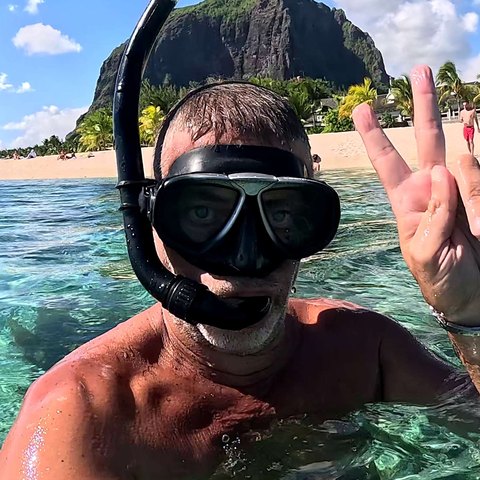
Stéphane Dubart, founder of Lead Lagoon, in the lagoon at Le Morne, Mauritius

Who wrote this document

Stéphane Dubart — SEO, email marketing and affiliate since 2004

I run Lead Lagoon, a web, SEO and AI agency based in Mauritius. We publish our own content sites — one of mine took the August spam update head-on, and that is the site this protocol was built on. It was then applied to 22 other affected sites, and refined on every pass.

This is not a compilation of blog posts written by someone who lost nothing: it is what I did when it was my own traffic sitting at zero. And every claim in the document links back to its official source — Google Search Status Dashboard, Search Central, Schema.org — so you can check all of it without taking my word for anything.

@zebusinessweb Verified account · 1,174 followers · Check who I am before you buy

Every day at zero is a day you will never get back.

Google will only reassess your site once the work is finished and properly signalled. Every week spent changing things at random pushes that moment further away — and sends you back to square one.

Get the protocol — $69

Instant download · Secure payment by Whop

SEO Recovery Protocol
16-page PDF · instant download
Get it — $69